I'm the kind of person that likes to analyse everything to death (and make lists).
1) Here's what I wrote on Synthesis: Low-Carb and Food Reward/Palatability, and Why Calories Count:-
"I’m going to stick my neck out here and state that fat, sedentary people do better on low-carb diets because:-
Fat, sedentary people have severe muscular insulin resistance.
This results in chronic hyperinsulinaemia and acute hyperinsulinaemia on eating carbs (which causes lethargy & increased sedentariness).
Chronic hyperinsulinaemia impairs the Phase I insulin response.
This impairs the stability of the blood glucose control system, resulting in large fluctuations in blood glucose level on eating carbs.
A rapidly-falling blood glucose level causes severe hunger pangs (I’ve experienced this under medical supervision).
Severe hunger pangs cause overeating, resulting in increased fatness.
GOTO 1
Low-carb diets reduce the large fluctuations in blood glucose level. Once normal blood glucose control has been restored by bodyfat loss & exercise, low-carb diet is no longer required."
I added a hot-link that wasn't in the original comment. Thanks to Sam Knox for linking to that study.
Lethargy & increased sedentariness result in very few calories burned (BMR/RMR + TEF). Eliminating (lethargy & increased sedentariness) greatly increases calories burned without conscious effort (BMR/RMR + TEF + TEA + NEAT/SPA). This is why people on low-carb diets can eat more and still lose weight. The Energy Balance Equation still applies.
2) I've noticed that people conflate Food Tastiness with Food Reward. Here's my opinion:-
Excessive reward = Moreish. What your food tastes like is only vaguely relevant. Avoid eating moreish foods, unless you're a body-builder who's trying to bulk.
Here's what I wrote on Food Reward: “There’s Always Room For Dessert”:-
"I believe that obesity is physiological AND neurological (the proportions varying from person to person).
For example, one chocolate doesn’t disturb my blood glucose & insulin, but I still crave another. And another. Ad nauseam."
Physiological cravings take hours to kick-in.
Neurological cravings take seconds to kick-in.
Emily Deans wrote:-
"Multiple times I’ve used naltrexone (an opiate blocker) to stop binge eating. The cravings go away. It only takes a few weeks. It’s a nice way to undo addiction/reward without starving someone… not FDA approved."
That's pretty damning evidence for the existence of Food Reward. How can naltrexone block something that doesn't exist?
Finally Monsieur, a waffer-thin mint.
Thursday, 8 March 2012

Monday, 5 March 2012
When nerds attack!
Things can get pretty steamy. As I mentioned in Both Sides Now: Nerds!, we can be a little obsessive.

Basically, everybody who blogs about Diet & Nutrition is a nerd to some degree. If you're that obsessive about your diet that you've achieved success with it, you must be nerdly inclined. So here's a list (nerds love to make lists) of some nerdy bloggers. This is meant to be a bit of fun, so don't go all nerdy on me and shoot the messenger!
In no particular order, but ladies first:-
1) CarbSane: I like Evelyn because of her no-BS style.
2) Denise Minger: Denise cracks me up with some of the stuff she comes out with. She has an infectious giggle when she's lecturing. She also has the cojones to take on giants like T. Colon Campbell (oops!).
3) Kurt Harris MD: This chap really knows his stuff. I majorly pissed Kurt off last year by nerdily sticking-up for Aldi's "Solesta" EVOO (it only has 6.6% pufas, Kurt!).
4) Richard Nikoley: This chap also really knows his stuff (except for one topic ;-D). I majorly pissed Richard off recently while discussing politics with him. We have totally different views. I goaded him into calling me a "miserable, dishonest, lying f*ck of a wasted f*ck." We seem to be getting on better, now. I mentioned politics once, but I think I got away with it!
5) praguestepchild : An ex-engineer, so an O.K. bloke. I goaded Sean into calling me a "hysterical c*nt". My bad!
6) Lyle McDonald: What Lyle doesn't know about Diet & Nutrition fits on a postage stamp. I've probably pissed him off as well!
7) LeonRover: Not a blogger, but he's proved invaluable in correcting me with expressions such as "Stone the flaming crows" and "No way, José".
Anyway, enough of all this silliness. It's time to visit mum.

Basically, everybody who blogs about Diet & Nutrition is a nerd to some degree. If you're that obsessive about your diet that you've achieved success with it, you must be nerdly inclined. So here's a list (nerds love to make lists) of some nerdy bloggers. This is meant to be a bit of fun, so don't go all nerdy on me and shoot the messenger!
In no particular order, but ladies first:-
1) CarbSane: I like Evelyn because of her no-BS style.
2) Denise Minger: Denise cracks me up with some of the stuff she comes out with. She has an infectious giggle when she's lecturing. She also has the cojones to take on giants like T. Colon Campbell (oops!).
3) Kurt Harris MD: This chap really knows his stuff. I majorly pissed Kurt off last year by nerdily sticking-up for Aldi's "Solesta" EVOO (it only has 6.6% pufas, Kurt!).
4) Richard Nikoley: This chap also really knows his stuff (except for one topic ;-D). I majorly pissed Richard off recently while discussing politics with him. We have totally different views. I goaded him into calling me a "miserable, dishonest, lying f*ck of a wasted f*ck." We seem to be getting on better, now. I mentioned politics once, but I think I got away with it!
5) praguestepchild : An ex-engineer, so an O.K. bloke. I goaded Sean into calling me a "hysterical c*nt". My bad!
6) Lyle McDonald: What Lyle doesn't know about Diet & Nutrition fits on a postage stamp. I've probably pissed him off as well!
7) LeonRover: Not a blogger, but he's proved invaluable in correcting me with expressions such as "Stone the flaming crows" and "No way, José".
Anyway, enough of all this silliness. It's time to visit mum.
Saturday, 3 March 2012
Warning signs to look out for when a heart attack is coming.
R.I.P. Davy Jones. I sang "Daydream Believer" at karaoke two nights running as a tribute.

The article Davy Jones Dead: Warning Signs to Look Out for When a Heart Attack is Coming caught my attention.
"At 66, Davy Jones appears to be living a healthy life. He was a vegetarian. He goes on a regular morning run. He was not just a horse owner but also a rider. Davy Jones seems to be generally fit and healthy to succumb to a deadly heart attack."
He's like H. Jay Dinshah, who also died of a heart attack at the age of 66. I strongly advise vegetarians & vegans to watch "Dr Greger: 2003 - Optimum Vegetarian Nutrition - Omega 3 and B12"

The article Davy Jones Dead: Warning Signs to Look Out for When a Heart Attack is Coming caught my attention.
"At 66, Davy Jones appears to be living a healthy life. He was a vegetarian. He goes on a regular morning run. He was not just a horse owner but also a rider. Davy Jones seems to be generally fit and healthy to succumb to a deadly heart attack."
He's like H. Jay Dinshah, who also died of a heart attack at the age of 66. I strongly advise vegetarians & vegans to watch "Dr Greger: 2003 - Optimum Vegetarian Nutrition - Omega 3 and B12"
Wednesday, 29 February 2012
How care homes are blinding their residents.
Now that I have your full attention (!), care & nursing homes are not blinding them in the conventional sense. What's in the picture below?
 I haven't the foggiest idea! I found the image using Google Image search and it's called blurry-1.jpg.
This is what the world looks like to residents who have either not been given their glasses, or who have been given their glasses but the lenses are filthy.
Mum's lenses were filthy this morning. I've written it in the book and informed the manager. Another lady has been at the home for ages and still doesn't have glasses, despite asking for them repeatedly. Her relatives didn't supply the home with any. This sort of thing makes me so mad!
Mum pays ~£1,000 a week to stay at this care home. It's well-run, but on mum's floor (severely disabled) during the day, there are 4 carers + 1 nurse for 18 residents. It takes 2 carers to bath or toilet a resident (my sister damaged her back and had to take early retirement, as there were no health & safety guidelines for lifting in her day) and there is a lot of paperwork.
EDIT: The care home is arranging for the lady whose relatives didn't supply the home with any glasses to get some, so it's not all bad news.
 I haven't the foggiest idea! I found the image using Google Image search and it's called blurry-1.jpg.
This is what the world looks like to residents who have either not been given their glasses, or who have been given their glasses but the lenses are filthy.
Mum's lenses were filthy this morning. I've written it in the book and informed the manager. Another lady has been at the home for ages and still doesn't have glasses, despite asking for them repeatedly. Her relatives didn't supply the home with any. This sort of thing makes me so mad!
Mum pays ~£1,000 a week to stay at this care home. It's well-run, but on mum's floor (severely disabled) during the day, there are 4 carers + 1 nurse for 18 residents. It takes 2 carers to bath or toilet a resident (my sister damaged her back and had to take early retirement, as there were no health & safety guidelines for lifting in her day) and there is a lot of paperwork.
EDIT: The care home is arranging for the lady whose relatives didn't supply the home with any glasses to get some, so it's not all bad news.
Monday, 27 February 2012
Discrimination is bad, mmmkay?
What do the following three images have in common? Images found with Google Image search.


They are all unable to fend for themselves or express how they feel. They all need a lot of care and attention and can be very demanding. The last two also have to be fed & toileted.
So why is it that the first two images make people go "Squeeeeeeee!" but the third one doesn't?
Is it because the first two images give you something to look forward to but the third one doesn't?
We're all going to end up old one day if we're "lucky". Just hope and/or pray that when you get there, you either have caring partners and/or relatives to look after you, or independent care for the elderly has improved a lot. I've seen things.
It's all in a day's work (as measured in Joules) Part 2.
Are you as aerobically-fit as this bloke?
 Emmanuel Mutai made it a Kenyan double after winning the Virgin London Marathon in a new course record. Mutai's time of 2:04.38, beats the previous best of 2:05.10 set by Samuel Wanjiru in 2009 and also the fifth-fastest time ever.
I'll take it that's a "no", then.
Elite marathon runners have optimised their metabolisms to use the minimum possible amount of muscle glycogen as fuel. Muscle glycogen storage is limited to ~1,680kcals-worth (~420g of carb)*.
Supercompensation (depletion followed by 3 days of carb-loading) can increase this figure to ~720g*.
Fat storage can amount to ~35,000kcals-worth (~10lb of fat), even in a skinny Kenyan like Mutai.
A blogger called Thor Falk took the data from It's all in a day's work (as measured in Joules) and plotted it as a graph in Fat vs carb burning – a N=1 chart. Here's the graph:-
 Even a super-fit Kenyan like Mutai burns some carbs when running at ~12.5 miles per hour. The less fit that somebody is, the more the first corner in the blue plot moves down and to the left. This results in more carbs being burned at energy consumption levels more than the first corner. This depletes muscle glycogen stores faster, resulting in "hitting the wall" (running out of muscle glycogen) sooner.
Muscles that are depleted of glycogen are more insulin-sensitive than muscles that have more glycogen, therefore the less aerobically-fit somebody is, the sooner their muscles become insulin-sensitive when they exercise.
*Assuming 20kg of muscle (Lore of Running P104)
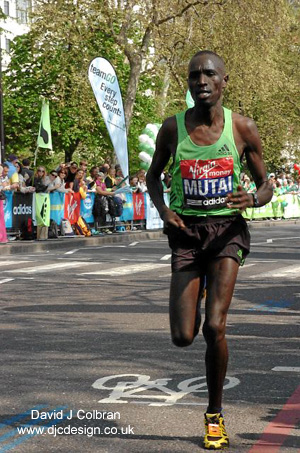 Emmanuel Mutai made it a Kenyan double after winning the Virgin London Marathon in a new course record. Mutai's time of 2:04.38, beats the previous best of 2:05.10 set by Samuel Wanjiru in 2009 and also the fifth-fastest time ever.
I'll take it that's a "no", then.
Elite marathon runners have optimised their metabolisms to use the minimum possible amount of muscle glycogen as fuel. Muscle glycogen storage is limited to ~1,680kcals-worth (~420g of carb)*.
Supercompensation (depletion followed by 3 days of carb-loading) can increase this figure to ~720g*.
Fat storage can amount to ~35,000kcals-worth (~10lb of fat), even in a skinny Kenyan like Mutai.
A blogger called Thor Falk took the data from It's all in a day's work (as measured in Joules) and plotted it as a graph in Fat vs carb burning – a N=1 chart. Here's the graph:-
 Even a super-fit Kenyan like Mutai burns some carbs when running at ~12.5 miles per hour. The less fit that somebody is, the more the first corner in the blue plot moves down and to the left. This results in more carbs being burned at energy consumption levels more than the first corner. This depletes muscle glycogen stores faster, resulting in "hitting the wall" (running out of muscle glycogen) sooner.
Muscles that are depleted of glycogen are more insulin-sensitive than muscles that have more glycogen, therefore the less aerobically-fit somebody is, the sooner their muscles become insulin-sensitive when they exercise.
*Assuming 20kg of muscle (Lore of Running P104)
Sunday, 26 February 2012
Zero medications.
As mentioned in Both Sides Now: Medications, some medications are essential, as they are hormones that the body can no longer produce for itself due to glandular dysfunction. Other medications act as dietary supplements. It's the medications that change how the body works which can cause problems.
Due to prostatitis, I had been prescribed the alpha-adrenoreceptor blocker Tamsulosin Hydrochloride at a dose of 400ug/day. This reduces constriction of sphincter muscles in the urethra, which alleviates urinary retention. However, it also affects arterioles, the iris in the eye, veins, the stomach, the intestines, male sex organs, the skin, the liver, pancreatic Acini & Islet (beta) cells, fat cells and salivary cells.
I stopped taking Tamsulosin and have had no problems weeing, so the prostatitis has gone. I'm now taking zero medications that change how my body works.
So eating less and moving more does have benefits.

Saturday, 25 February 2012
Cheapest Vitamin D3 yet.
A big thank you to Ted Hutchinson for bringing Vitamin D3 to my attention. Healthy Origins, Depot Vitamin D3, 125mcg (5,000IU) is very reasonably priced (£26.56 for 360 gelcaps which is a year's supply at 2026 prices).

Tuesday, 21 February 2012
How care homes are starving their residents to death.
Now that I have your full attention (!), care & nursing homes give their residents plenty to eat & drink, so they are not starving them to death in the conventional sense.
So, what am I talking about? Clue:- UVB cannot penetrate window glass.
I'm talking about Vitamin D starvation.
At this time of year, care home residents are dying like flies. My sister (who worked in a care home years ago) told me that this is normal. Three died at mum's care home in the same week recently. All of the residents have one thing in common. They're all pale.
Old people feel the cold, so if they do go outside between March and September, they're covered from head to toe in clothes. They synthesise minimal Vitamin D in their skins for their bodies to store. Then, between September and March, their bodies use up those stores. Vitamin D levels decay exponentially , with a half-life of about 60 days. As Vitamin D levels fall, the risk of getting viral infections greatly increases, mood worsens, aches and pains worsen, blood glucose control worsens, the risk of getting cancer greatly increases. Need I go on?
As Dr. Richard M. Cooper (Private GP, Harley Street) pointed out, ALL of his patients were low in Vitamin D and they were active people who could go outdoors. Many care home residents can't go outdoors. They can get a paltry 400iu Vitamin D from an Adcal-D3 chewable tablet, but they're huge things that taste like sweetened chalk and cause constipation (mum hated them).
Death by Vitamin D starvation is a long, drawn-out process that reduces the quality & length of life for care home residents. Something needs to be done about it. All care home residents should have their serum Vitamin D levels tested and be given Vitamin D3 accordingly. I have broached this subject with the manager of mum's care home.
Mum's on 5,000iu/day of Vitamin D3. Although she is now fairly non compos mentis, she still smiles a lot and laughs at my dreadful jokes. She is also infection-free.
Here's the transcript of a YouTube video that's since been removed.
"At this care home, they're proud of their varied menu. Even so, the Government recommends supplements for the over 65's as well as children under 3 and women who are pregnant or breast-feeding. But health charities are demanding clearer guidelines and better advice. Because research into Vitamin D deficiency has revealed associations with all sorts of conditions, including Multiple Sclerosis, Diabetes, Arthritis, Osteoporosis, Heart Disease and even some cancers."
Dr Carrie Ruxton (Award-winning dietitian and health writer. Media commentator on diet, food and nutrition issues. Advisor to the food industry and government) said:-
"What I think the Government should do is promote its own policies. It had a policy for years to recommend Vitamin D supplementation for vulnerable groups, like elderly, housebound and pregnant & lactating women and children but at the moment, that's not being done. In my own example, I was pregnant twice and nobody told me to take Vitamin D supplements."
This is unacceptable. As the manager at mum's care home is not responsible for the residents' supplementation, I will be taking this up with the MP for the area.
Update: I spoke to the nurse on Friday 2nd March about mum's medical history. Before Vitamin D3, mum had a Urinary Tract Infection in the previous 9 months. Since Vitamin D3, mum has had no medical problems and she has been happy & contented. Her serum Vitamin D level is in the normal range.
Sunday, 19 February 2012
You can’t please all of the people...
...all of the time. I see that I've lost a few followers recently. I guess some of my recent posts have been too controversial. The triple-whammy of bad things that happened last year (and which sent me into several months of depression) have all been resolved and my mood is now very positive.
I don't write posts to gain followers. I'm not trying to start a new religion. I write in order to dump my thoughts to hard copy so that I can go over them and also so that you can critique them.
I've just added Food Politics to my blog list. Marion Nestle writes about it, so I don't have to.
I don't write posts to gain followers. I'm not trying to start a new religion. I write in order to dump my thoughts to hard copy so that I can go over them and also so that you can critique them.
I've just added Food Politics to my blog list. Marion Nestle writes about it, so I don't have to.
Oh no, not again!
Today's title is a quote from Douglas Adams' "The Hitchhiker's Guide to the Galaxy".
There seems to be a lot of hysteria & worry around the Internet.
Oh, noes! They took away her lunch-box (they didn't)! Her lunch-box! That's crap!
Oh, noes! They made her eat chicken nuggets (they didn't)! Chicken nuggets! That's crap!
Oh, noes! They made her eat a portion of grain! A portion of grain! That's crap!
Oh, noes! They wanted to give her a carton of skimmed milk! Skimmed milk! That's crap!
Oh, noes! They wanted to give her a carton of chocolate milk! Chocolate milk! That's crap!
Is there too much fat in this Guacamole?
Is there too much omega-6 in this pork?
Is there too much BPA in this bottled water?
And so on...
Firstly, chicken nuggets, grains, skimmed milk and chocolate milk are not crap. They're not perfect, but they're far better than chocolate/candy bars and fizzy drinks.
Schools act in loco parentis, so they are not going to feed the children crap. USDA guidelines are nowhere near perfect, but children who aren't humongously fat are metabolically-flexible. Therefore, whether they eat carbohydrates or fats, their bodies will burn them. If a child has been diagnosed with Coeliac disease, they won't be given gluten grains (unless the school wants to get sued).
Eat some carbs, dammit. See Why I Ditched Low Carb.
To quote from The Hitchhiker's Guide to the Galaxy again, DON'T PANIC! The dose makes the poison. Dietary fructose is used by the liver to make blood glucose to run red blood cells & the brain. A non-keto-adapted brain uses ~140g/day of glucose. Therefore, in the absence of any other dietary carbohydrates, a child could eat 100g/day of fructose, or 200g/day of sucrose without harm. Obviously, other carbohydrates are being eaten, so the amount of fructose that can be eaten without harm is probably ~50g/day, or ~100g/day of sucrose, or ~90g/day of HFCS55.
Warning, irony alert. So, light up a large spliff and chill a bit! Here's a song to help.
EDIT: Worrying about "X" may be worse for you than "X" itself, due to the adverse effect of chronically-elevated cortisol.
Tuesday, 14 February 2012
Does it really matter?
I mean, does it really matter exactly how & why low-carb diets work? My thoughts...
There's a lot of in-fighting on the internet about low-carb & paleo diets etc. Which is "best", exactly how they work and so on. I don't believe that there is a best diet. Everyone is different (in genetics, environment, activity etc). To boil it down to the basics:-
1) Eat real food that hasn't been buggered-about with too much. Grains that have had the outer husk removed (e.g. white rice) are O.K. Grains that have been rolled flat or inflated to a large size by heating to >100°C are O.K. Grains that have been ground into dust are not O.K.
2) If eating "X" causes you problems, stop eating "X". If certain proteins cause you problems, you either have a genetic condition (e.g. coeliac disease) or excessive gut permeability. The first isn't fixable but the second may be. If certain carbohydrates cause you problems, you either have a genetic problem or insulin resistance. The first isn't fixable but the second may be.
The real enemy here is the food manufacturers. They don't want people to stop eating their highly-profitable Crap-in-a-Bag/Box/Bottle (CIAB), as it's bad for business. They also influence Governments. So let's stop fighting amongst ourselves and attack the real enemy any way that we can. Lead by example.
Monday, 13 February 2012
Vitamin D video.
By Dr. Richard M. Cooper (Private GP, Harley Street). Thanks to Dexter Yard for posting this on my Facebook wall.
Part 1
Part 2
N.B. In the UK, the normal level for serum Vitamin D is 75 to 200nmol/L, not International Units (IU). Divide by 2.5 to convert to ng/mL.
Part 1
Part 2
N.B. In the UK, the normal level for serum Vitamin D is 75 to 200nmol/L, not International Units (IU). Divide by 2.5 to convert to ng/mL.
Tuesday, 24 January 2012
Use 'em or lose 'em
Hello world. I'm back. The title is referring to our muscles. The following image is from Masters Athletes Show the Importance of Exercise on Aging Muscle..

I'm not going to start doing chronic exercise, but the above is a great incentive to continue with the walking.

I'm not going to start doing chronic exercise, but the above is a great incentive to continue with the walking.
Sunday, 17 April 2011
No System Sounds on XP? Buttons greyed-out?
Kerrie "did something" to her fiancée's lap-top resulting in the loss of all Windows System sounds, also all sound using Firefox, though iTunes & RealPlayer produced sound just fine.
On Start >> Settings >> Control Panel >> Sounds, the Play button for System sounds was greyed-out. The record & play buttons on Sound Recorder were also greyed-out.
After many hours of unsuccessful tinkering, the problem was eventually solved HERE.
K-Lite Codec Pack 7.1.0 STANDARD version also contains a very nice Media Player.
Saturday, 16 April 2011
The Vitamin D Association is organising 2 conferences in London in May
that might be of interest to you and your colleagues:
May 17 Vitamin D & Obstetrics – Improving Pregnancy & Childbirth
Some of the world’s foremost experts will show the strong evidence that higher levels of Vitamin D lead to easier conception, easier pregnancy, less gestational diabetes, less pre-eclampsia, reduced risk of emergency C-sections and an easier delivery, followed by less depression in the mother and a larger, healthier baby. There is also evidence that the risk of Type-1 Diabetes in the child is reduced and that the child will have stronger bones and teeth.
Professor Bruce Hollis will discuss findings from his recent Trials on vitamin D supplementation during pregnancy and breastfeeding. He is the director of Paediatric Sciences at the Medical University of South Carolina and has studied vitamin D metabolism and nutrition for the past 35 years. He has published significant scientific papers on the biomarkers of Vitamin D in the body as they relate to a number of illnesses
Professor Reinhold Vieth is Professor of Nutritional Sciences and Laboratory Medicine and Pathobiology at the Mount Sinai Hospital in Toronto, Canada. His current research focuses on the roles played by vitamin D in many illnesses and especially gestational diabetes, plus toxicity and safe blood serum levels.
Professor Hollis and Professor Vieth will release findings of their recent work on what mothers and health professionals need to know about vitamin D – information that they hope will help clarify new guidelines for safe sun exposure, supplementation and suitable dietary sources of vitamin D.
More at: www.vitamindassociation.org/events
May 18 Vitamin D & Cancer – Treatment & Prevention
Long-term Vitamin D deficiency is associated with many cancers, osteoporosis, multiple sclerosis, diabetes, insulin resistance, hypertension, heart disease, respiratory infections, muscle weakness, mood and cognitive function and infectious diseases such as influenza.
There is strong evidence that high levels of Vitamin D both help the body recover from cancer and also play a major part in preventing cancer.
Professor Joan Lappe is professor of medicine at Creighton University in USA. She will report on the results of a major Level 1 Randomised Controlled Trial that showed the preventive actions of Vitamin D and calcium against cancer.
Dr. Enikö Kállay will provide practical advice for Oncologists and other medical professionals about the latest genetic tests for diagnosis and treatment of cancer. She is Assistant Professor at the Medical University of Vienna, Department of Patho-physiology and Allergy Research, where she studies the role of Vitamin D and dietary calcium in the prevention and pathogenesis of colorectal cancer, with special emphasis on the CYP24 gene.
More at: www.vitamindassociation.org/events
Friday, 8 April 2011
Vitamin D Experts' Forum at the Wellcome Trust in London, England on Thursday 7 April 2011
I was there! See below.
The Vitamin D Association is running a major event in London designed to give an overview of the range of illnesses and treatments where Vitamin D is involved.
Speakers include Dr. Michael F. Holick, Dr. Reinhold Vieth, Dr. William B. Grant, Carole Baggerly, and Dr. David Grimes.
There will be ample time allocated to participate in open discussion about new treatment guidelines and protocols and to share your knowledge and clinical experiences.
The event is targeted at senior medical personnel, general practitioners, nutritionists, dieticians and other health care professionals.
Timetable
08:30 Registration
09:30 Chairman’s opening remarks. Rufus Greenbaum (Vitamin D Project Manager, Systems Biology Laboratory)
09:35 Vitamin D: A D-lightful story for good health. Dr Michael F Holick
10:30 UK Overview – Statistics about Vitamin D in the UK. Rufus Greenbaum
10:45 Discussion
11:00 Break
11:15 The Impact of improving Vitamin D levels – health & financial outcomes. Dr William B Grant
11:45 Vitamin D & Cancer – current trials and evidence. Carole Baggerly
12:15 Discussion
12:30 Lunch
1:30 Public Policy on Vitamin D. Dr Oliver Gillie
2:00 Clinical experiences in a UK hospital. Dr David Grimes
2:30 Discussion
2:45 Break
3:00 Treatment & Toxicity – Benefits and dangers of supplementing with Vitamin D. Dr Reinhold Vieth
3:30 Discussion – All
4:30 Closing Remarks. Mike Fischer, Director, Systems Biology Laboratory
Here's a graphic from the Forum:-

What I found interesting is the fact that some medical conditions follow a J curve vs serum 25(OH)D level. This suggests that people may be suffering from deficiencies in some of the other fat-soluble vitamins (A, E's & K's) due to the modern fad for low-fat diets. Hypovitaminosis K2 results in inappropriate calcification at high serum 25(OH)D level, which increases the risk factor for Coronary Heart Disease.
Unfortunately, the fact that highish (greater-than 50nmol/L, or 20ng/mL) serum 25(OH)D levels can cause harm, results in continuing Fear, Uncertainty & Doubt about Vitamin D and "expert" (e.g. the US Institute Of Medicine) advice that 600iu/day is sufficient for optimum health. See 7th April 2011: Vitamin D - Experts' Forum for more info'.
Anyway, here's me and my God-daughter Kerrie getting some free Vitamin D on Wednesday evening!

Cheers!
Saturday, 2 April 2011
Has anybody seen my tinfoil hat?
This morning, I left two comments on Peter (Hyperlipid)'s blog. The second one has disappeared. EDIT: It went into the spam filter. It's visible again.
Some time later, Jay Bryant phoned me and asked me where my blog had gone.
"It's still there" I said, then refreshed the page. "Shit, it's gone!"
I managed to reinstate my Blog but apparently, there has been "unusual activity" on it. Hmmm. I just noticed that I'm following my own blog! How did that happen? Spurious follow now deleted.
This calls for a music video...
Monday, 21 March 2011
New beginnings, cot'd.
As a result of New beginnings. , I've demolished my wall and I now want to start a new relationship. I've got a lot of love to give and I want to find that special lady to give it to. Here's the ideal music video.
I won't be blogging so much in future.
P.S. Mum had a Mini Mental State Examination today. She got a score of 12 (out of 28 things that she was physically capable of). 6 months ago, she got a score of 9 (out of 27 things that she was physically capable of). Ketogenic Diet For The Win.
She'll be tested again next year. I found out on Wednesday 23rd March that she is being given 5,000iu/day of D3. I didn't expect that to happen.
Saturday, 12 March 2011
Get in!
Here's a music video.
Remember Polite Requests? Well, yesterday at mum's nursing home, the nurse in charge called my name. She sounded rather stern, so I thought that I was going to get a slapped wrist for talking too loudly again (as I do, because I'm a bit deaf). But no!
She said that I hadn't done anything wrong. She wanted to talk about mum's Vitamin D blood test result. My eyes lit up. She said that the result had been "temporarily mislaid" (whatever that means), but that they had now found it and it was "normal" at 98nmol/L (RR 50-200nmol/L). Divide by 2.5 to convert into ng/mL. I said that I already knew this as I had spoken to Dr F**'s secretary.
She then said with a smirk "Dr F** knows what you're like (I also smirked) and has agreed that mum can have a serum Vitamin D level of around 125nmol/L. He said to buy some of this." She handed me a piece of paper with the word "cholecalciferol" written on it.
What should have happened: I put my left hand into my right inside jacket pocket and whipped out a tub of Healthy Origins, Depot Vitamin D3, 125mcg (5,000IU) with flair and panache.
What actually happened: The pot snagged on something and I had to tug on it for about five seconds to get it out.
I then handed the pot to the nurse and told her to get on with it. Job done!

Subscribe to:
Posts (Atom)